
Stone is a material whose appearance signals permanence, craftsmanship and quality within the built environment. Although it makes a powerful statement, natural stone has always come with real costs in dollars, labor and environmental impact. For architects, builders and homeowners seeking the look of quarried stone without all the tradeoffs, manufactured stone has come forward as an attractive alternative.

Manufactured stone has evolved a great deal in the past few decades. While earlier manufactured stone products could appear flat and artificial, today’s products are cast from molds created from real, hand-selected stone, delivering authentic texture and depth. They capture the undercuts, shadow lines and color variation that make natural stone so visually rich. The result are components that project authenticity from a distance and up close.
“Over the last decade, we have seen manufactured stone prove itself time and time again,” says Jarrod Garrett, manager at Martin Borchett in Little Rock, Ark. “Its lightweight construction, large selection and prompt availability have allowed this product to shine, but cost savings are why more customers are choosing manufactured stone. Whether it's adorning a new hotel or a homeowner finally turning their seasoned home into a dream home, manufactured stone has helped establish today’s benchmark for a modern project.”
Sustainable and Flexible
There are also advantages that go beyond aesthetics. Manufactured stone has a meaningfully lighter environmental impact than its quarried counterpart, which is an important consideration for many when it comes to material choice. Extracting stone from the Earth is a process that disturbs land, consumes fuel for heavy equipment and requires long-haul transport from quarry to job site. Conversely, manufactured stone is produced in an efficient manner using aggregates, cement, and mineral oxide pigments and cast in molds at a manufacturing facility.
The industry also takes resource conversation seriously. Leading manufacturers incorporate recycled water into their production lines, often supported by rainwater-capture systems that reduce dependence on municipal supply. Some facilities have added solar arrays that offset a share of the electricity used in production and reduced associated carbon emissions. None of this compromises the finished product's durability or appearance; it simply means the beauty of stone can be achieved with a reduced ecological impact.

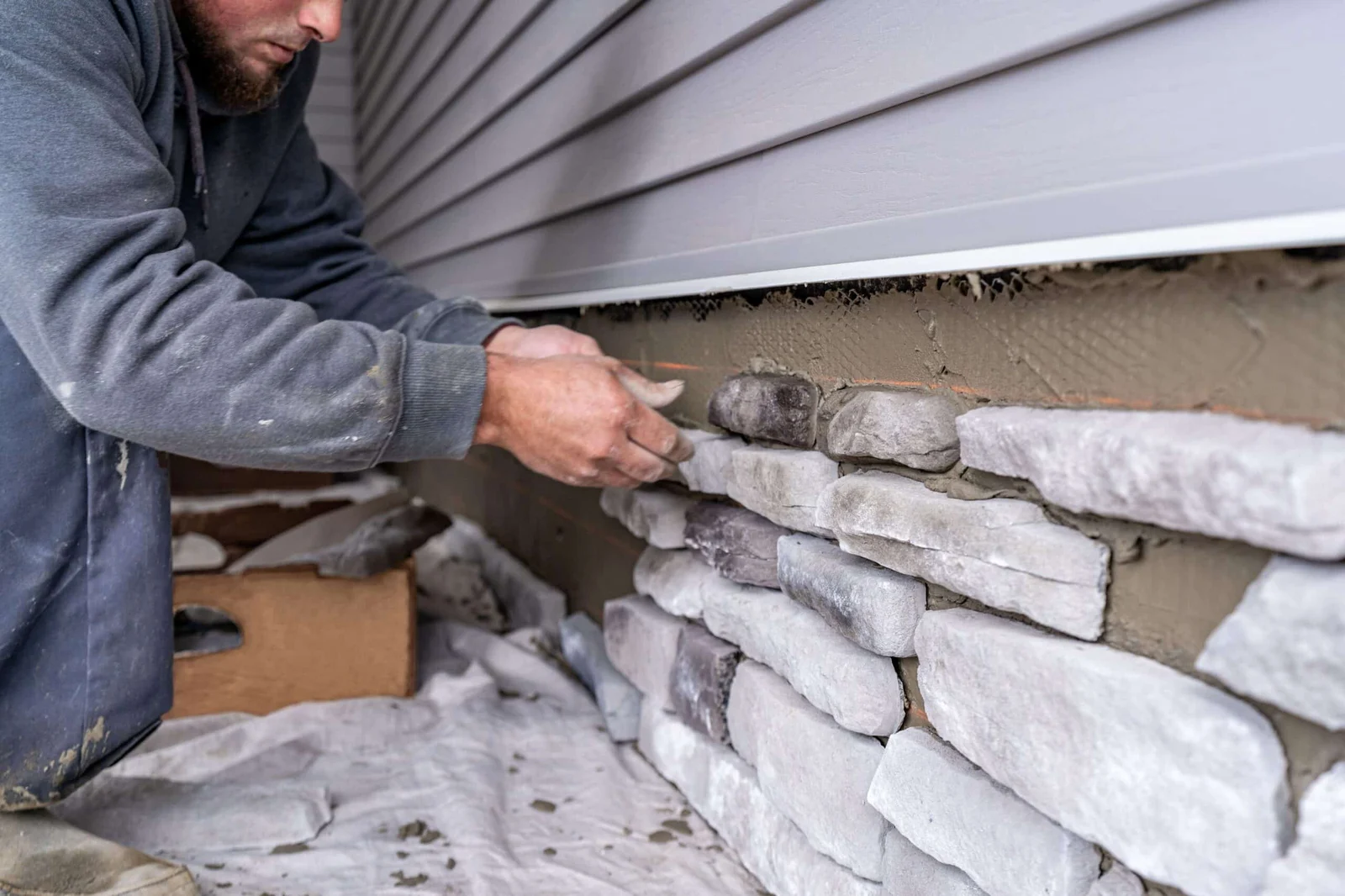
Installers also appreciate the relative ease of application that comes with manufactured stone. Natural stone and brick installations are constrained by how quickly mortar can set up before the next course is laid. If this is rushed, a wall's structural integrity suffers. Manufactured stone doesn’t have that limitation. Every piece is cast with a flat back so installers can set courses more quickly and consistently.
Less time and less complexity ultimately mean less cost. Installation efficiency translates directly into labor savings, which matters for new-construction budgets and remodeling projects where contractor time is often the largest line item. For architects and builders pressed by tight schedules, it's a practical reason to specify manufactured stone even when budget isn't the primary driver.
Inside and Out
It's easy to think of manufactured stone purely as a façade treatment because that is how it is often seen. Many consider it a material that dresses up a home's lower third or wraps a foundation. While that is a prominent use case, manufactured stone’s versatility extends beyond cladding. Porch columns, entryway surrounds, chimney chases and mailbox posts are common applications. With a range of available profiles, including tightly fitted ledgestone, rugged fieldstone and cut stone, the material can suit nearly any architectural style—from a Craftsman bungalow to a modern farmhouse.
This flexibility makes manufactured stone a popular choice for renovation and retrofit projects where the goal is often to refresh a home's street presence without a full exterior overhaul. A stone-clad porch column or entry surround can transform curb appeal at a fraction of the cost and disruption of what it takes to reclad the whole house.
As outdoor living has become a permanent fixture of residential design, manufactured stone has found a natural home. Outdoor kitchens, built-in grill surrounds, pizza ovens and bar areas can be finished in stone veneer. This provides weather resistance and visually ties the outdoor space to the architecture of the house itself. Manufactured stone delivers lasting performance and aesthetic appeal when incorporated into exterior living projects, like retaining walls, seat walls and planters.

Because manufactured stone is engineered to withstand freeze-thaw cycles, UV exposure, and moisture, it holds up to the demands of an outdoor kitchen or fire feature just as reliably as it does on a home's primary façade. This all comes without the sealing and maintenance concerns that can come with natural stone in high-exposure settings.
Inside the home, manufactured stone has become a favored substitute for real stone or brick in fireplace surrounds and accent walls. It offers designers a way to introduce texture and warmth into a living room or great room without the weight, cost or structural considerations that natural stone can require. Interior applications also benefit from the same manufacturing consistency that makes exterior installations faster: predictable sizing and flat backs simplify the work for interior masons and tile installers alike, whether the project is a full fireplace wall or a smaller accent behind a media console.
A simple value proposition ties all these threads together. Manufactured stone delivers the aesthetic impact of natural stone with fewer constraints. It's produced with a smaller environmental footprint, installs faster and adapts to nearly any application a design calls for—whether that is exterior cladding, structural accents, outdoor living features or interior focal points. For architects, builders and homeowners evaluating material options, the blend of sustainability, practicality and design versatility is making manufactured stone an increasingly compelling choice.
PHOTOS: courtesy ProVia